
Introduction
Natural and eco-friendly cleaning products have become a default choice in many premium homes. The appeal is understandable — they are positioned as safer, gentler, and more considered than conventional chemical cleaners. For most surfaces, that reputation is reasonable. For marble, travertine, and limestone, it can lead to permanent, irreversible damage.
The mechanism is not immediately obvious, which is why the damage often goes undetected until it is extensive. Understanding it clearly — and understanding which products to avoid and why — is one of the most practical things an owner of a premium home can know.
The Chemistry Behind the Damage
Marble, travertine, and limestone are calcium carbonate-based stones. This composition gives them their characteristic appearance — the depth, the veining, the natural warmth — but it also makes them chemically reactive to acid.
When an acidic substance contacts the surface of a calcium carbonate stone, a chemical reaction occurs: the acid dissolves the calcite crystals at the molecular level, removing the polished surface and leaving behind a dull, rough, pitted area. This is called etching, and it is distinct from staining. A stain sits on or in the stone. Etching is the physical removal of the stone itself. It cannot be cleaned away. Restoration requires professional honing or re polishing.
The reaction is not slow. A few drops of vinegar left on a polished marble countertop for ten minutes can produce a visible etch mark. Direct contact with lemon juice causes damage almost immediately on contact.
Why ‘Natural’ Does Not Mean Safe for Stone
This is where the assumption does most of its damage. Many natural and eco-friendly cleaning products are formulated with acidic active ingredients — specifically because those ingredients are effective at cutting grease, dissolving mineral deposits, and leaving surfaces smelling clean.
The two most common are:
- Vinegar (white or apple cider): pH approximately 2.4, strongly acidic. One of the most frequently recommended DIY cleaning agents, and one of the most common causes of marble etching. The word ‘natural’ does not modify its pH.
- Citrus-based cleaners: Lemon juice has a pH of approximately 2.0, more acidic than vinegar. Many commercial ‘natural’ or ‘eco’ sprays use citric acid as an active ingredient. The cleaning action on grease and limescale comes precisely from this acidity — the same acidity that etches stone.
It is worth checking the ingredients of any product labelled as natural, eco, or green before using it on stone surfaces. The scent of a product is not a reliable guide — many non-citrus products contain citric acid as a chelating agent. The relevant question is pH, not origin.
The Products That Are Safe
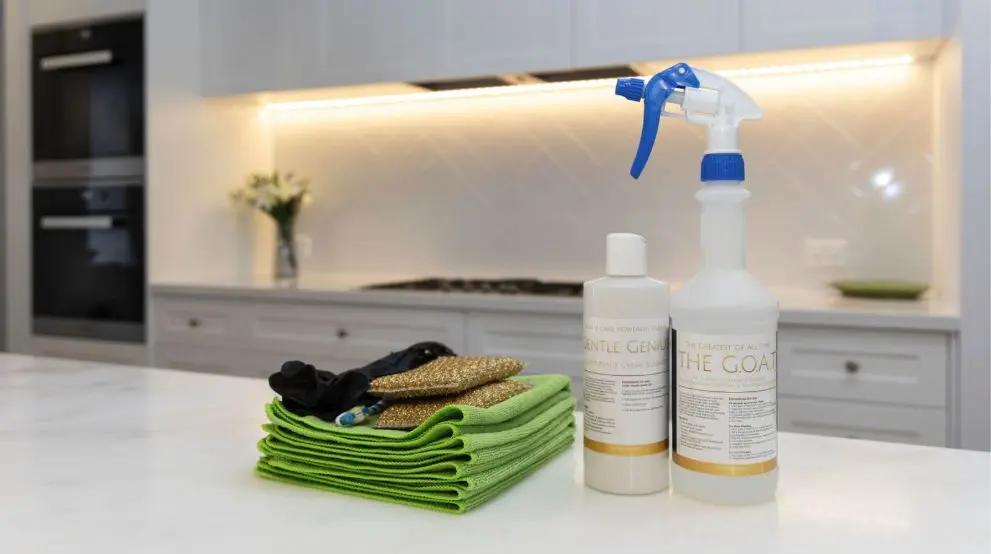
The standard for cleaning marble, travertine, and limestone is straightforward: pH-neutral, stone-specific products only. A pH of between 6.5 and 7.5 is the appropriate range. Products formulated specifically for natural stone — rather than general-purpose or natural cleaners — are designed with this requirement in mind.
For routine maintenance between professional cleans, a small amount of pH-neutral dish soap dissolved in warm water is a practical and safe option. The key is rinsing thoroughly to avoid residue build-up, which can itself cause a dull, hazy appearance over time.
What to avoid entirely: vinegar, lemon juice, citrus-based sprays, bathroom tile cleaners, grout cleaners, bleach (alkaline, and damaging in different ways), and any all-purpose spray that does not specify stone-safe formulation.
What This Means for Premium Homes
In a home where marble, travertine, or limestone features in kitchens, bathrooms, entry halls, or outdoor areas — and in many premium Brisbane homes, it features in all of these — the cleaning products used matter considerably. The value of these surfaces is both financial and aesthetic. Restoring an etched marble floor or benchtop to its original finish is a specialist and costly undertaking. Preventing the damage in the first place is straightforward, once the chemistry is understood.
This is a significant part of what distinguishes a preservation-minded cleaning service from a general one. Knowing which products are appropriate for which surfaces — and applying that knowledge consistently across every visit — is not an optional refinement. It is fundamental to protecting the home.
What to Do if Damage Has Already Occurred
Etch marks on marble or travertine present as dull, rough, or cloudy patches that do not respond to cleaning. If you notice these on polished stone surfaces, the cause is almost certainly acid contact — whether from a cleaning product, a spill (wine, citrus fruit, vinegar dressings), or accumulated use of the wrong cleaner over time.
The appropriate response is professional stone restoration — typically diamond honing to remove a fine layer of stone and restore the original finish, followed by sealing. This is specialist work and not a DIY repair. The earlier it is addressed, the less material needs to be removed and the closer the restoration can come to the original finish.
At Luxe Clean, our approach to all premium surfaces is product-specific and informed by the material being cleaned. We do not use general-purpose products on stone. It is one of the more concrete ways in which considered professional cleaning protects the home rather than compromising it.

